
THE LANCE
February 15, 2012
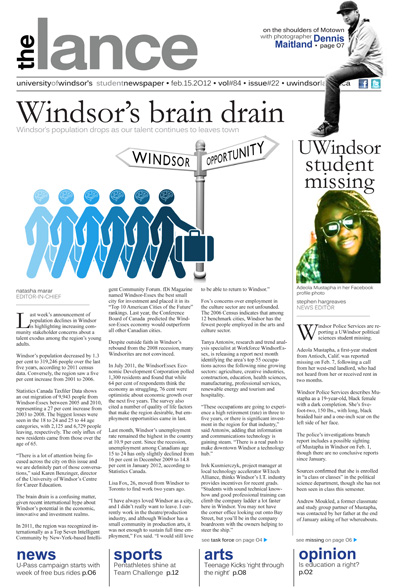
Windsor’s population drops as our talent continues to leave town
L ast week’s announcement of population declines in Windsor is highlighting increasing community stakeholder concerns about a talent exodus among the region’s young adults.
Windsor’s population decreased by 1.3 per cent to 319,246 people over the last five years, according to 2011 census data. Conversely, the region saw a five per cent increase from 2001 to 2006.
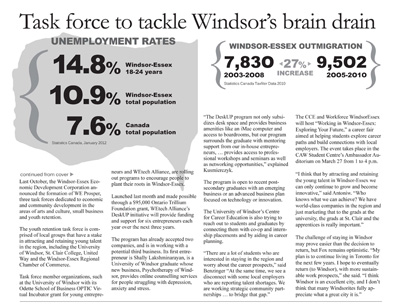
Statistics Canada Taxfiler Data shows an out migration of 9,943 people from Windsor-Essex between 2005 and 2010, representing a 27 per cent increase from 2003 to 2008. The biggest losses were seen in the 18 to 24 and 25 to 44 age categories, with 2,125 and 6,729 people leaving, respectively. The only influx of new residents came from those over the age of 65.
“There is a lot of attention being focused across the city on this issue and we are definitely part of those conversations,” said Karen Benzinger, director of the University of Windsor’s Centre for Career Education.
The brain drain is a confusing matter given recent international hype about Windsor’s potential in the economic, innovative and investment realms.
In 2011, the region was recognized internationally as a Top Seven Intelligent Community by New-York-based Intelligent Community Forum. fDi Magazine named Windsor-Essex the best small city for investment and placed it in its “Top 10 American Cities of the Future” rankings. Last year, the Conference Board of Canada predicted the Windsor-Essex economy would outperform all other Canadian cities.
Despite outside faith in Windsor’s rebound from the 2008 recession, many Windsorites are not convinced.
In July 2011, the WindsorEssex Economic Development Corporation polled 1,300 residents and found that while 64 per cent of respondents think the economy as struggling, 76 per cent were optimistic about economic growth over the next five years. The survey also cited a number of quality of life factors that make the region desirable, but employment opportunities came in last.
Last month, Windsor’s unemployment rate remained the highest in the country at 10.9 per cent. Since the recession, unemployment among Canadians age 15 to 24 has only slightly declined from 16 per cent in December 2009 to 14.8 per cent in January 2012, according to Statistics Canada.
Lisa Fox, 26, moved from Windsor to Toronto to find work two years ago.
“I have always loved Windsor as a city, and I didn’t really want to leave. I currently work in the theatre/production industry, and although Windsor has a small community in production arts, it was not enough to sustain full time employment,” Fox said. “I would still love to be able to return to Windsor.”
Fox’s concerns over employment in the culture sector are not unfounded. The 2006 Census indicates that among 12 benchmark cities, Windsor has the fewest people employed in the arts and culture sector.
Tanya Antoniw, research and trend analysis specialist at Workforce WindsorEssex, is releasing a report next month identifying the area’s top 55 occupations across the following nine growing sectors: agriculture, creative industries, construction, education, health sciences, manufacturing, professional services, renewable energy and tourism and hospitality.
“These occupations are going to experience a high retirement (rate) in three to five years, or there is significant investment in the region for that industry,” said Antoniw, adding that information and communications technology is gaining steam. “There is a real push to make downtown Windsor a technology hub.”
Irek Kusmierczyk, project manager at local technology accelerator WEtech Alliance, thinks Windsor’s I.T. industry provides incentives for recent grads. “Students with sound technical know-how and good professional training can climb the company ladder a lot faster here in Windsor. You may not have the corner office looking out onto Bay Street, but you’ll be in the company boardroom with the owners helping to steer the ship.”
Last October, the Windsor-Essex Economic Development Corporation announced the formation of WE Prosper, three task forces dedicated to economic and community development in the areas of arts and culture, small business and youth retention.
The youth retention task force is comprised of local groups that have a stake in attracting and retaining young talent in the region, including the University of Windsor, St. Clair College, United Way and the Windsor-Essex Regional Chamber of Commerce.
Task force member organizations, such at the University of Windsor with its Odette School of Business OPTIC Virtual Incubator grant for young entrepreneurs and WEtech Alliance, are rolling out programs to encourage people to plant their roots in Windsor-Essex.
Launched last month and made possible through a $95,000 Ontario Trillium Foundation grant, WEtech Alliance’s DeskUP initiative will provide funding and support for six entrepreneurs each year over the next three years.
The program has already accepted two companies, and is in working with a potential third business. Its first entrepreneur is Shally Lakshminarayan, is a University of Windsor graduate whose new business, Psychotherapy of Windsor, provides online counselling services for people struggling with depression, anxiety and stress.
“The DeskUP program not only subsidizes desk space and provides business amenities like an iMac computer and access to boardrooms, but our program surrounds the graduate with mentoring support from our in-house entrepreneurs, … provides access to professional workshops and seminars as well as networking opportunities,” explained Kusmierczyk.
The program is open to recent post-secondary graduates with an emerging business or an advanced business plan focused on technology or innovation.
The University of Windsor’s Centre for Career Education is also trying to reach out to students and graduates by connecting them with co-op and internship placements and by aiding in career planning.
“There are a lot of students who are interested in staying in the region and worry about the career prospects,” said Benzinger “At the same time, we see a disconnect with some local employers who are reporting talent shortages. We are working strategic community partnerships … to bridge that gap.”
The CCE and Workforce WindsorEssex will host “Working in Windsor-Essex: Exploring Your Future,” a career fair aimed at helping students explore career paths and build connections with local employers. The event takes place in the CAW Student Centre’s Ambassador Auditorium on March 27 from 1 to 4 p.m.
“I think that by attracting and retaining the young talent in Windsor-Essex we can only continue to grow and become innovative,” said Antoniw. “Who knows what we can achieve? We have world-class companies in the region and just marketing that to the grads at the university, the grads at St. Clair and the apprentices is really important.”
The challenge of staying in Windsor may prove easier than the decision to return, but Fox remains optimistic. “My plan is to continue living in Toronto for the next few years. I hope to eventually return (to Windsor), with more sustainable work prospects,” she said. “I think Windsor is an excellent city, and I don’t think that many Windsorites fully appreciate what a great city it is.”